

Color Correctness Shouldn’t Depend on Your Monitor
For thirty years, getting medical color and grayscale right has meant buying the right monitor. QUBYX is changing where that correctness lives — moving pixel-level control off the display and into the PACS, so any qualified screen can be DICOM- and color-correct.
Color is trapped inside the monitor
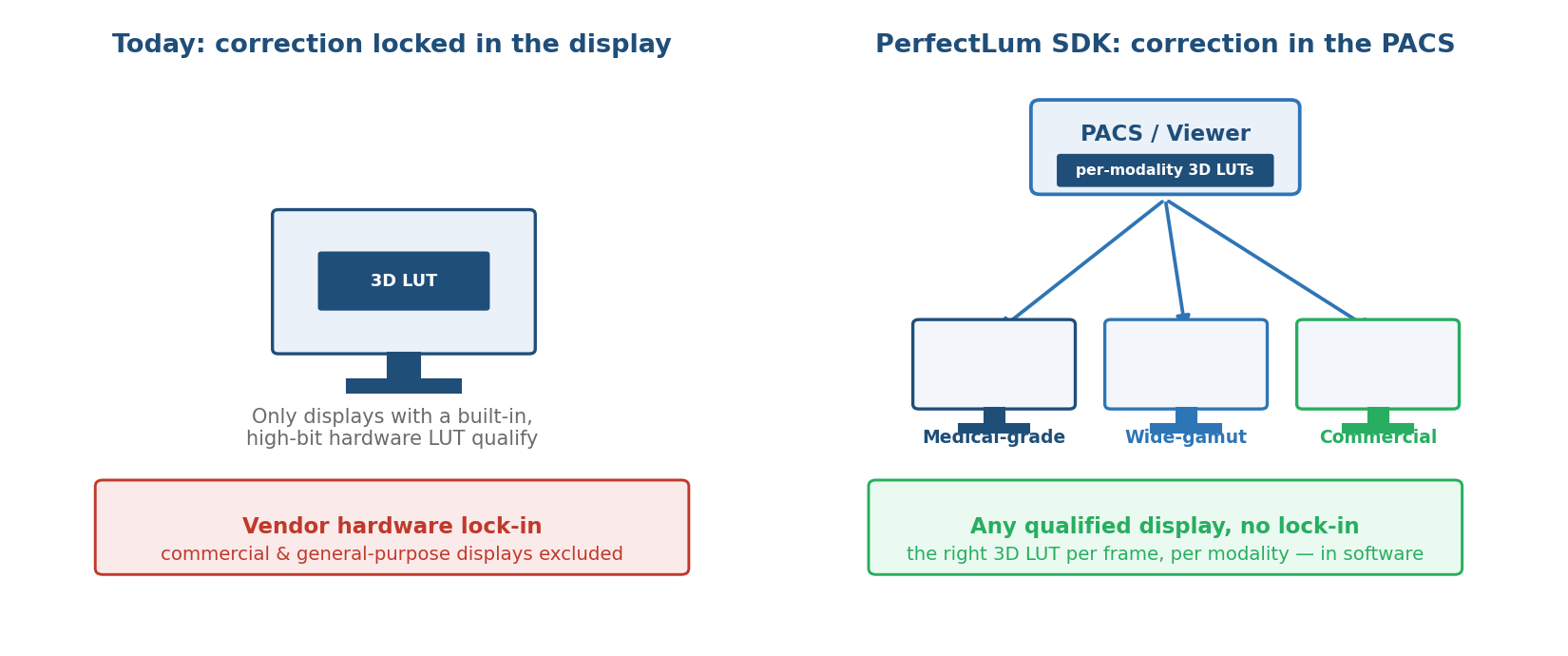
On today’s reading stations, the color and grayscale behavior of an image is governed by the display. A medical-grade monitor is calibrated, the correction is baked into its internal hardware look-up table, and every image routed to that screen is rendered through that single transform. It works — but it ties correctness to a narrow class of displays built with high-bit internal LUTs, and it cannot be simultaneously right for a grayscale radiograph and the color overlays, pathology slides, and Doppler loops sitting beside it on the same screen.
The practical effect is lock-in. If “correct” requires a proprietary hardware LUT inside the panel, then commercial and general-purpose displays are excluded by definition, mixed fleets drift apart, and every workstation upgrade is a hardware decision.
Move the 3D LUT to where the image is rendered
QUBYX takes a different path: deliver the correction as a 3D LUT applied inside the PACS or viewer, not inside the monitor. Because the application owns the pixels, it can apply the right transform to the right frame — DICOM GSDF grayscale in the radiology viewport, perceptually uniform color for a functional overlay, a pathology profile for a whole-slide image — all on one screen, at the same moment, on whatever qualified display is attached.
The correction travels with the image and its modality, rather than being fixed to the panel. And because it runs in the application, it does not depend on the operating system or the monitor to honor an ICC profile — the long-standing gap that has held software color management back.
What that changes for you
- No display lock-in. Medical-grade, wide-gamut, or commercial — any qualified display can be made DICOM- and color-correct.
- Per-modality accuracy. A different 3D LUT per frame means grayscale and color are each correct at the same time, on the same screen.
- Consistent mixed fleets. Different panels are matched to what they can all reproduce, so a finding looks the same from one station to the next.
- Lower cost, more freedom. Color correctness becomes a capability of your software, not a line item on a monitor purchase order.
Built on PerfectLum, delivered as an SDK
This is enabled by the PerfectLum SDK, which lets PACS and medical-imaging software manufacturers build full DICOM calibration, color management, and 3D LUT support directly into their own applications. It handles the parsing, the ICC A2B/B2A LUT structures, and the perceptually correct application of the transform — so a team can add standards-compliant color management to a viewer or PACS client without building a color pipeline from scratch. It builds on QUBYX’s established PerfectLum DICOM calibration platform and the company’s open tools for 3D LUT and ICC profile generation.
Color correctness shouldn’t depend on which monitor you bought.
Talk to QUBYX about integrating the PerfectLum SDK — and bringing pixel control to the PACS. www.qubyx.com
Writes about display calibration and the workflows that depend on accurate color. Part of the QUBYX team since 2018.
